

Answer Engine Optimization is the practice of making a brand retrievable, accurate, and recommendable inside AI-generated answers, measured by how often engines cite or name you rather than by where you rank.
There is no single AI index and no shared rulebook: OpenAI, Perplexity, Google and Anthropic each run their own retrieval, and Google states outright that no AI-specific optimization exists. Most of what decides whether an engine names you sits on domains you do not own, which is why the work has an order, and why teams that start with blog posts usually move nothing.
A buyer who used to type “best project management software for agencies” into Google and scan ten blue links now asks the same question in ChatGPT and gets four vendors in a paragraph. If you are one of the four, you are in the consideration set. If you are not, there is no page two to be on.
Ten positions, a stable list, and a click you can attribute. Being eighth was disappointing but survivable, because eighth still existed on the page.
Four names in a paragraph. There is no fifth place, no page two, and nothing to click if you were left out. You are in the set or you are invisible.
This page is the reference for the whole discipline: what AEO is, how the engines differ, what you can actually influence, and how to tell whether any of it worked. Every claim about how an engine behaves links to that vendor’s own documentation.
What exactly is answer engine optimization?
Answer Engine Optimization (AEO) is the practice of making a brand retrievable, accurate, and recommendable inside AI-generated answers, measured by how often engines cite or name you rather than by where you rank.
Three words in that sentence are doing all the work, and they describe three separate things that can fail independently. That split turns AEO from a vague ambition into something you can diagnose.
Retrievable
Can the engine find material about you when it goes looking?
- Failure looks like
- Silence. You are not named at all, and neither are your pages.
- Usually caused by
- Crawler access, or an entity the engine cannot resolve.
Accurate
Is what it then says about you actually true?
- Failure looks like
- Wrong pricing, a feature you removed, or the wrong category entirely.
- Usually caused by
- A stale third-party profile the engine trusts more than your own site.
Recommendable
When the question is a buying question, are you one of the options?
- Failure looks like
- Described correctly, never shortlisted.
- Usually caused by
- Thin third-party evidence next to the competitors that do get listed.
Note what the definition does not contain. It says nothing about keywords, nothing about position, and nothing about traffic. Those are the units of search engine optimization, and they do not survive the move to answers.
How is AEO different from SEO?
AEO is not a replacement for SEO, and anyone selling it as one is selling something. Google’s own documentation is blunt about the overlap.

On Google’s surfaces, the entry ticket is ordinary technical SEO. What changes is everything after the entry ticket.
| Search engine optimization | Answer engine optimization | |
|---|---|---|
| Unit of visibility | A ranked URL | A named brand or a cited source inside one answer |
| Result shape | Ten positions, stable enough to track daily | Prose that varies between runs of the same prompt |
| Query input | Keywords, often short | Full questions, often with constraints and context |
| Primary lever | Content and links on your own domain | Evidence about you across the whole corpus |
| Success metric | Position, impressions, clicks | Citation rate, mention rate, share of the recommendation set |
| Failure mode you can see | Ranking drops | Silence, or a confident wrong description |
If the unit of visibility has changed, it is worth being precise about what a single answer actually contains, because three different things in it map to three different metrics.
The row in that table causing the most trouble is the second one. Search results are close to deterministic, so a rank tracker sampling once a day tells you something real. Answers are not.
A ranking drop is loud. AEO failure is quiet: nothing breaks, no dashboard turns red, and you simply stop being mentioned in conversations you never saw.
Which engines are we actually talking about?
“AI search” is not one system. It is a handful of separate retrieval stacks with different crawlers, different corpora and different citation behaviour, wearing ten different product names.
 AI Mode
AI Overviews
AI Mode
AI Overviews
 Grok
Meta AI
Grok
Meta AI
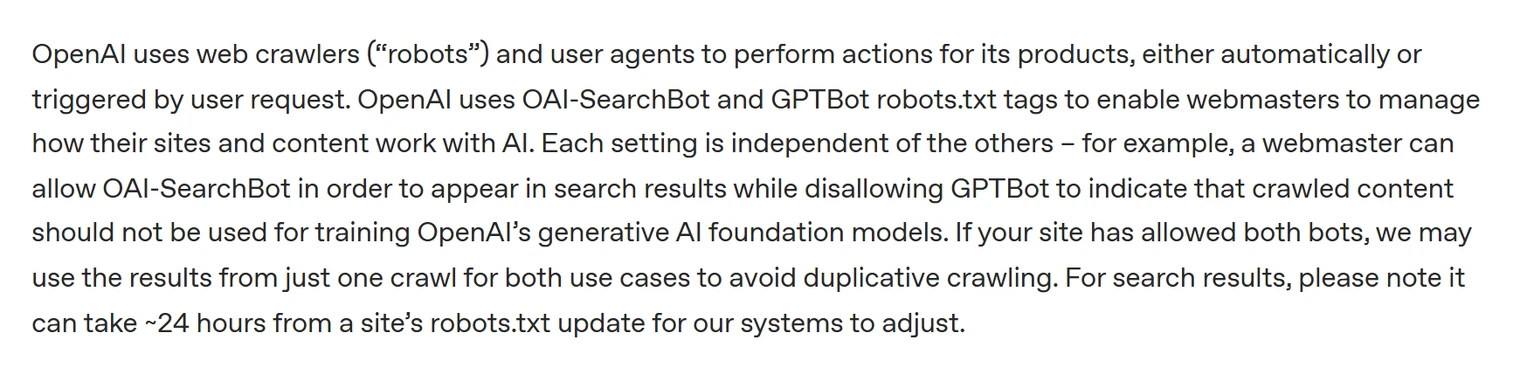
The vendors that publish how their crawlers work draw a distinction that matters more than any tactic. There is a crawler for training, a crawler for the search index behind the product, and a fetcher that goes out when a user asks a question in real time.
OAI-SearchBot
Surfaces websites in ChatGPT’s search features. This is the one that decides whether you can appear in an answer at all.
Allow this one
GPTBot
Crawls for model training. Blocking it is a defensible choice and it does not remove you from ChatGPT’s search results.
Your call
PerplexityBot
Surfaces and links websites in Perplexity’s results. Explicitly not used for model training.
Allow this one
ChatGPT-User
Fetches a page because a person asked for it by name. Both OpenAI and Perplexity note that robots.txt rules may not apply to this class of visit.
Ignores robots.txt
Which makes the correct robots.txt short and specific rather than a blanket rule.
# Answer surfaces: allow, or you cannot be named
User-agent: OAI-SearchBot
Allow: /

User-agent: PerplexityBot
Allow: /

# Training crawler: your call, and independent of the above
User-agent: GPTBot
Disallow: /User-agent: * block with a broad disallow does not distinguish between these, and it is the version that quietly removes you from answers.Perplexity documents the same split, between PerplexityBot for surfacing and linking, and Perplexity-User for user-initiated visits. Blocking crawlers does not make you invisible to a user who names you. It makes you invisible to everyone who does not already know your name, which is the audience you were trying to reach.
Why Google’s surfaces have to be counted separately
A conversational assistant. Retrieval depth varies with how the question is asked.
AI Mode
A dedicated answer surface inside Search, with its own follow-up behaviour.
AI Overviews
A summary above ordinary results, triggered on some queries and not others.
How do engines decide which brands to name?
Nobody outside these companies knows the ranking function, and any confident claim to the contrary is marketing. What is documented is the architecture, and the architecture constrains what is possible.
The pattern behind most answer engines is retrieval-augmented generation, set out in Lewis et al., “Retrieval-Augmented Generation for Knowledge-Intensive NLP Tasks”.
Facts stored in the weights at training time. The paper’s own observation is that a model’s “ability to access and precisely manipulate knowledge is still limited” this way, and it cannot be updated without retraining.
An external corpus fetched during the request. This is the part you can influence, because it is made of documents that exist on the open web today.
“Best project management tool for a 12-person agency?”
Whatever the retriever pulled, ranked by its own criteria.
Your site Review platforms Comparison articles Community threads Press and docsFour vendors named in a paragraph, with sources attached.
source 1source 2source 3Two things follow. If your material is not retrievable at query time, no amount of it existing helps. And the model is summarising a set of documents that are mostly not yours, so your own site is one voice in that set and rarely the loudest.
This is why AEO work that starts and ends with publishing on your own blog underperforms so reliably. It is optimising the one input the engine weights least.
Why is an AI citation not a backlink?
The two get conflated constantly, and the differences are not cosmetic.
| Backlink | AI citation | |
|---|---|---|
| Exists | Persistently, in a page’s HTML | For one answer, to one prompt, at one moment |
| Accumulates | Yes, it is a stock you can audit | No, it is a rate you have to sample |
| Origin | Somebody chose to link to you | A retriever surfaced a document and a model quoted it |
| Points at | Your domain | Any source that mentioned you, often not yours |
| Measured by | Counting | Repeated runs against a fixed prompt set |
The consequence is that one run tells you nothing. Ask the same engine the same question repeatedly and the set of named vendors moves.
Which leaves two very different measurement problems.
Count what exists today. The same audit run twice returns the same answer, and last year’s links are still there to inspect.
Hold the prompts and the run count constant, then measure frequency over time. Nothing accumulates, so there is no back catalogue to inspect later.
A citation earned through a G2 profile or a community thread counts as visibility and contributes nothing to your domain, which is uncomfortable for anyone whose reporting still ends at sessions.
Does structured data change what AI says about you?
This is where AEO advice goes furthest off the rails, so it is worth being careful. Google’s position on its own surfaces is explicit.
The AI features documentation tells site owners not to build AI-specific text files, custom markup, or special structured data. There is no llms.txt that Google reads and no AI schema type.
Google describes it as helping search understand a page. It is a disambiguation tool, and Google’s documentation makes no claim that it improves ranking position.
The property that carries most of that weight is sameAs on schema.org’s Organization type, defined as the “URL of a reference Web page that unambiguously indicates the item’s identity.”
{
  "@context": "https://schema.org",
  "@type": "Organization",
  "name": "Your Company",
  "url": "https://yourcompany.com/",
  "sameAs": [
    "https://en.wikipedia.org/wiki/Your_Company",
    "https://www.wikidata.org/wiki/Q00000000",
    "https://www.linkedin.com/company/yourcompany"
  ]
}sameAs pointing at a page nobody wrote is worse than no sameAs at all.Where an entity actually gets confirmed
Evidence you did not create is worth more than evidence you did. That single sentence explains most of the sequencing decisions in this discipline.
What can you actually control?
Split the surface into what you own, what you influence, and what you only observe. Most wasted AEO effort comes from treating the third band as if it were the first.
Crawler access, structured data, pricing and documentation pages, the claims you publish, named authors.
Direct controlReview platform profiles, directory listings, analyst mentions, documentation on partner sites, what customers write about you.
Slow, biggest effectThe retrieved set, the model’s phrasing, which competitors get named alongside you.
No controlThe owned band’s most important item is also its dullest: let the right crawlers in. Worth knowing that robots.txt is weaker than people assume in both directions.
It tells crawlers which URLs they may fetch, which is exactly the lever that decides whether an answer engine can see you at all.
Google states it “is not a mechanism for keeping a web page out of Google,” and that a disallowed page “can still be indexed if linked to from other sites.” See the robots.txt introduction.
One owned-band item carries unusual weight, because it is the one thing engines can attribute. Google’s helpful content guidance asks whether “it is self-evident to your visitors who authored your content,” whether “pages carry a byline, where one might be expected,” and whether the content “clearly demonstrate[s] first-hand expertise.” A named author with real credentials costs a decision rather than a budget.
How do you measure any of this?
Measurement is the part that separates a discipline from a set of opinions. Four things have to be held constant or the numbers are decorative.
Hold those four and you get metrics that mean something.
How often an answer links to your domain.
Did they send anyone to us?How often you are named at all, link or no link.
Do they know we exist?How often you appear when the question is a buying question.
Are we on the shortlist?What was said when you were named.
Is this visibility helping?Composite scores are convenient for a trend and dangerous if you cannot see inside them. Ours is documented component by component in the PPS score reference. Apply the same test to any tool you evaluate, including this one.
What order should the work happen in?
Sequence matters more than any individual tactic, because these layers depend on each other.
Fix the prompt set, run it long enough to see the volatility band, write down the baseline. Two to three weeks of daily data is usually enough to know what normal looks like.
Skip this and every later result is unfalsifiable.Consistent naming, consistent description, correct category, and sameAs pointing at whatever independent references already exist.
Review platforms, directories, comparison pages, community presence, documentation that lives on somebody else’s domain.
Slowest layer, largest effect. Which is why it gets skipped.Last, deliberately. Owned content amplifies evidence that already exists and does very little on its own.
Run this first and you spend a year publishing with nothing to show.It also explains a common and confusing result: a brand with excellent SEO and no AI visibility. Ranking well means your pages are good. Being named means the corpus agrees about what you are.
What does AEO not do?
A discipline is more credible for its limits, so here are the real ones.
An answer that names you and sends no click is invisible in analytics. Someone can read about you today and arrive by direct traffic a fortnight later, and nothing joins those events.
There is no submission form and nothing to buy. You improve the odds across many prompts and many runs. A vendor promising a specific mention is describing something they do not control.
Being in the consideration set is worth a great deal when there is demand for the category. It creates none.
Engines ship changes constantly, and a corpus that shifted under you last quarter will shift again. This is a monitoring discipline more than a project.
If you want to see how this plays out across the tools in the category, including where competitors are the better fit, our comparison hub states the method alongside the price and dates every figure.