
Read your first results
When the first checks land, what each number means, and what to do in your first week.
Your prompts are saved and the first checks have run. This page explains what you are looking at, which numbers are trustworthy on day one, and what to actually do in your first week.
When results appear
- Paid plans check daily. The first results usually appear within minutes and are complete within a few hours, depending on queue depth and how many engines your plan includes.
- Free plan checks weekly, so your first full picture can take up to seven days.
- Results stream in as each engine responds, so a partially filled dashboard is normal for the first hour, not a fault.
What is trustworthy on day one
Not every number means something immediately, and treating a first-day figure as a trend is the fastest way to make a bad decision.
| Number | Useful on day one? | Why |
|---|---|---|
| Citation rate | Yes | A single run already tells you whether you are in the answer at all, which is the main thing. |
| Answer text | Yes, most of all | The stored wording is the richest thing in the product on day one. Read it. |
| Competitors cited | Yes | Who the engines name instead of you is visible from the first run. |
| Sentiment | Mostly | Reliable per answer, but the distribution needs a few dozen answers to be meaningful. |
| PPS score | Partly | The value is computed immediately; its consistency component needs several runs to settle. |
| Trend arrows and deltas | No | A change figure needs a prior period. Expect these to be blank or noisy for roughly the first week. |
Read the answers, not just the score
The instinct is to look at the big number. The higher-value move on day one is to open Results and read the stored answer text for two or three prompts where you were not cited.
Nearly always, the reason is visible in the wording. Common patterns:
- The engine cites a comparison article you have not written, published by a competitor or a review site.
- The engine describes your category correctly but names three older, better-documented products.
- The engine mentions you with a stale fact: an old price, a discontinued feature, a positioning you abandoned.
- The engine answers a slightly different question than the one you assumed, which means the prompt needs rewording.
Your first look at the Overview
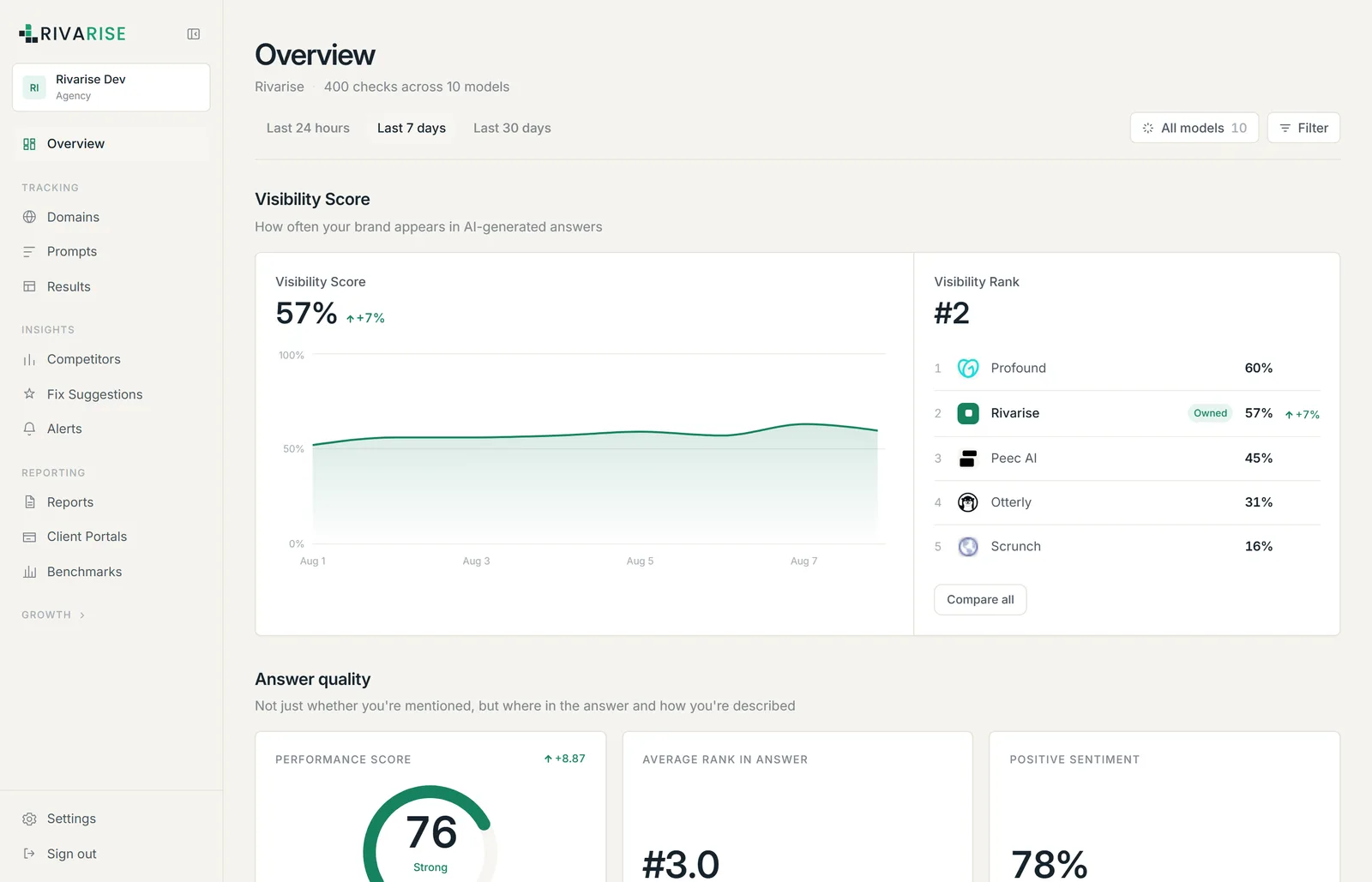
Four things to look at, in this order:
- Visibility Score. The share of checks in the selected range where your domain was cited. This is the headline.
- Visibility Rank. Where you sit against the competitors you added, by the same measure. Rank matters more than the raw percentage, because a 30 percent citation rate is strong in a crowded category and weak in a narrow one.
- Performance Score. The PPS, from 0 to 100, with a word label such as Strong or Weak. See The PPS score.
- Average rank in answer. When you are cited, how early you appear. Being named eighth in a list is not the same as being named first.
What to do in week one
- Day 1: read ten answers. Pick the five prompts that matter most commercially and read the full text from at least two engines each. Write down the actual reason you are missing from each.
- Day 1: add your real competitors. Go to Competitors and add the rivals the engines are naming, not the ones on your internal battlecard. They are often different, and that gap is itself a finding.
- Day 2: fix the prompts that missed. If an engine answered a different question than you intended, reword. Do this early, before you accumulate history against a bad instrument.
- Day 3: set one alert. A citation rate drop alert on your main domain is enough to start. See Alerts.
- Day 7: look at the trend, not the level. You now have a week of daily points. The direction is the signal; a single day's number never was.
A realistic expectation
Most brands find their first-week citation rate lower than they assumed, and find that the engines cite a competitor or a review site they were not tracking. That is the normal result, and it is the reason to measure rather than assume.
Improving it is content work, not a setting inside Rivarise. Fix suggestions tells you where the gap is; closing it happens on your site and in the sources the engines read. Engines also update on their own schedules, so a fix shipped today may show up in days, or in considerably longer, and some never land at all. Daily tracking is how you tell which happened.
Next
To understand what is happening behind the scenes, read How tracking works.